
Subtotal: $0.00 Cart

Harold Davis Uses Moab Paper for Artisanal Inkjet Prints

Freedom Paper created an insightful blog post on Moab Master, Harold Davis, using Moab Paper for his own creative work. 

"To make photographic art, it’s not essential to print your own images. But to experience your full creative potential, you may want to – especially when you can easily order so many different types of Moab Paper and other top brands of inkjet photo papers from Freedom Paper.

For example, renowned photographer-artist-author-teacher Harold Davis can’t imagine letting someone else print his images. Printing is how he fully realizes the image he envisions before he even snaps the camera shutter or opens Photoshop.

Harold Davis signs the first copy of his fine-art portfolio, Botanique. The portfolio blends contemporary photography and printing techniques with old-world bookmaking methods. Photo courtesy of Harold Davis.

After experimenting with many different papers, he became a fan of Moab paper and was named a Moab Master in 2012.  He prints some of his HDR (High Dynamic Range) images on Moab Slickrock Metallic inkjet paper and has created floral images such as “Peonies mon amour” on the Unryu paper that is part of Moab’s collection of Japanese Washi papers.

In addition to making individual prints, Harold Davis and his wife, graphic designer Phyllis Davis, have collaborated on a series of limited edition, handmade portfolio books. Their first book project, Botanique, was a Kickstarter-funded project that featured 21 original botanical art prints on archival vellum, Moab Moenkopi Unryu Washi, Moenkopi Kozo Washi, Moab Slickrock Metallic Pearl, and Colorado Fibergloss photographic paper. Each book was hand-cut and bound by hand. The book includes three panoramic-sized prints as foldouts and ships with a signed 9 x 12 inch print of Harold Davis’ popular image, “Red Peonies.”
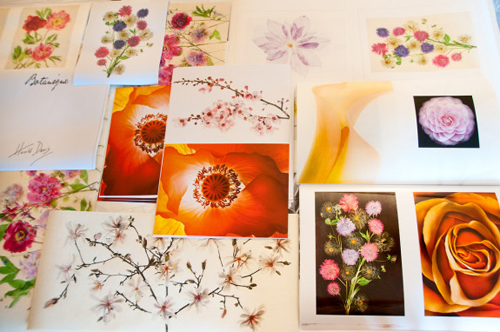
The floral images in “Botanique” show what’s possible with the digital workflow and backlighting technique Harold Davis invented to create luminous translucent imagery. For the portfolio pages, Davis chose the Moab inkjet or art paper that best matched the boldness or delicacy of the image. Photo: ©Harold Davis

Harold and Phyllis are currently working on his next limited edition portfolio, “A Modern Pilgrimage: Kumano Kodo.” This collection will feature a series of 13 images including a 9 x 26 inch panorama printed on a 16 ½ foot long roll of Moab Moenkopi kozo washi. The paper will be folded and placed in a signed cover that is itself a mountain panorama of Japan.
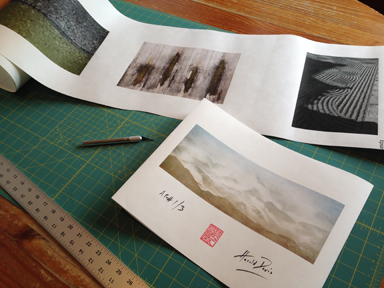
Pages for the Kumano Kodo portfolio are printed on the roll and hand trimmed, scored, signed, and bound. Photo: ©Harold Davis

“One of the most important things a printmaker can do is match the surface of the paper with the image,” says Davis. “Some images go well with some papers, and look terrible on others.” He acknowledges that it takes a fair amount of trial and error to discover the right paper for your images. But this experimentation is integral to your ability to develop a body of work that is yours alone.

For the Star Magnolia spread in “Botanique,” Harold Davis chose Moab Moenkopi Unryu Washi paper. Photo: ©Harold Davis

In a post on his blog entitled, “Making the Artisanal Inkjet Print,” Davis notes that prints created using a high-end inkjet printer go by a variety of names, including: inkjet print, pigment print, giclée, and piezo print. Like many art gallerists and collectors, Davis favors the term “pigment print.”

He attributes the widespread confusion of terminology to the incredible diversity of uses of inkjet technology: “You can buy inkjet prints at Costco, where they are honestly labeled. You can buy the somewhat pretentiously named giclee prints from companies that reproduce art. Or you can collect one-off artisanal pigment prints from a solo artist like me who makes the prints one at a time in his studio.”

While Costco, giclée printmakers, and solo artists may all use the same make and model of wide-format inkjet photo printer, the difference between a mass-produced decorative print and an artisanal inkjet print is about much more than what printer was used. Harold points out that three photographers can use the exact same cameras and produce results that are vastly different in artistic style and technical quality. Solo artists who own wide-format printers tend to craft artisanal prints one at a time and fuss over every detail.

“Quality in digital printmaking really comes down to know the quirks of the printer, understanding how to get the most out of digital workflow, how the technology is used, the vision behind the printmaking, and the care and time that is spent on each individual image,” explains Davis. “Just as much craft, skill, and artistry go into making a good artisanal digital inkjet print as ever went into a print made in the chemical darkroom.”

“If you include output file preparation, printing, and post-printing issues, an average print might take five to ten hours,” says Davis. “Sometimes I print an image 20 times until it is right and I get that one great print.”

For example, learning how to make perfect prints on specialty papers such as Moab’s Moenkopi Washi papers may require adjusting the pressure your printer exerts on the papers so they feed through the printer properly. The surface of the Slickrock Metallic paper is quite delicate and can be easily scratched. Yet the polyester content of the metallic inkjet paper makes it difficult to cut, even with the printer’s onboard cutter.

“A relatively unusual image is going to marry nicely with Slickrock Silver,” said Davis. “You have to be going for something that’s not a classic look.” Plus, you have to be aware of how the print will be lit. The colors in the image may look different when the print is viewed from different angles.
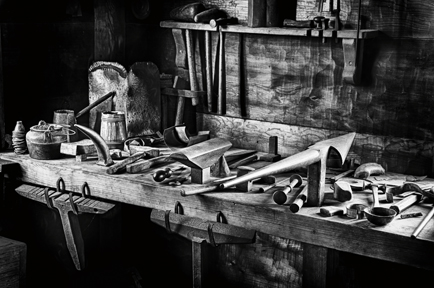
This HDR monochrome image of a workshop at the Fort Ross Historic Park takes full advantage of the qualities of Moab Slickrock Metallic Silver 300 paper. Photo: ©Harold Davis

Davis has been crafting his own art prints and art books for about 10 years, drawing upon his years of experience as a accomplished painter, commercial photographer, and author of dozens of books on technical subjects.

In the 1980s, Harold Davis spent a lot of time in darkrooms while supporting himself as a commercial photographer. He made his own color and black-and-white prints, and worked closely with lithographers. He says, “Making prints has always been a part of my story as a professional photographer.”

In the 1990s, Davis got married and left New York. He held a number of different jobs and started writing a series of computer-related books. When his publisher asked him to write a book on digital photography in 2004, Davis picked up a digital SLR for the first time and discovered that with a digital camera, Photoshop, and other software, he could combine his love of painting with his love of photography.  He considers his current Photography 2.0 career vastly different from his Photography 1.0 career in the 1980s.
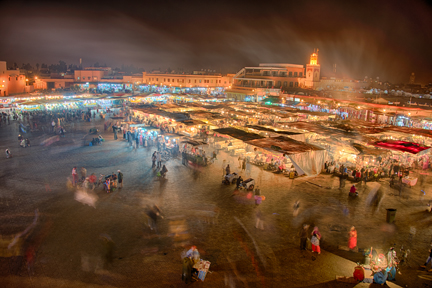
Harold Davis’ talent as a painter is evident in this beautifully rendered photograph of the Jamaa-el-Fnaa marketplace in Marakesh, Morocco. It was printed on Moab’s new Juniper Baryta Rag 305 paper. Photo: © Harold Davis

Harold Davis describes his current work as “Digital paintings that use photographs as the medium.” With this unique style, Davis is at the forefront of an emerging art movement in which creative photographers can do far more than capture an elusive moment in time. Thanks to Photoshop (which recently celebrated its 25th anniversary), photographic artists such as Harold Davis can now create images that depict almost any type of scene or subject they can envision in their mind’s eye.
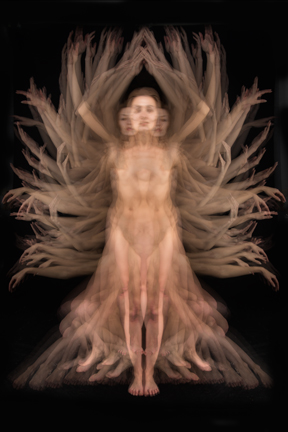
In this multiple exposure image, Harold Davis envisions image “Hekatonkheires” the three mythical Greek gods of violent storms and hurricanes. The artisanal pigment print takes full advantage of the qualities of Moab Slickrock Metallic Pearl 360 paper. Photo: ©Harold Davis

His collectors agree that Davis is doing important work. One individual who has collected Harold Davis’ work for more than five years says he is increasingly excited about the possibilities created by Harold’s unusual and effective use of technology in support of the classical tenets of photographic art: “I would compare his work to Ansel Adams’ and Edward Weston’s work during the crucial 1930s and 1940s time frame.”

To inspire other creative souls who want to push the boundaries of what’s possible with photography today, Harold Davis conducts workshops and posts instructional webinars. Some of the photography books he has written include:

  • Monochromatic HDR Photography
  • Creating HDR Photos
  • Photographing FlowersPhotographing Waterdrops
  • Creative Black & White
  • Creative Lighting
  • Creative Landscapes
  • Creative Close-ups

In his award-winning photography book, “The Way of the Digital Photographer,” Davis emphasizes that previsualizing an image should not only include how a shot is composed and lit but also how it will be processed in Photoshop and printed.

His next book, which Focal Press has scheduled for publication in August, 2015, is entitled “Achieving Your Potential as a Photographer.” The book’s subtitle is “A Photographer’s Creative Companion and Workbook.” The book presents an organized and cohesive plan for kickstarting creativity, and then taking the resulting work into the real world. The concepts are accompanied by a workbook with exercises you can use to put them into everyday practice.

When Harold Davis was selected as a Moab Master, Marc Schotland, vice president of marketing and global development for Legion Paper said, “Harold is a renowned photographer, artist and author who offers a unique vision and voice to the Moab Masters program. Harold’s meticulous printing skills are present in every print he produces, and we’re thrilled that he chooses Moab as the paper to support his images.”

Freedom Paper is proud to offer an excellent selection of Moab paper and Moab Chinle archival boxes and portfolios for protecting and presenting your work. We also sell a sampler pack that includes 2 sheets of 16 different types of Moab photo and art papers.

We encourage all photographers to continue to experiment and see what’s possible with Photography 2.0."


 

Photographers are Sleepwalking into a 'Photographic Armageddon'

"Photographers must print images they want to preserve, or treasured photos may be unavailable to future generations when digital storage media wears out or becomes obsolete." -Chris Cheesman

Amateur Photographer Magazine reports the "stark warning from the Royal Photographic Society (RPS) and Photo Marketing Association after Google vice-president Vint Cerf recently warned of a ‘digital dark age’ where data stored on computers will be lost for ever.

"Speaking at a meeting of the American Association for the Advancement of Science in San Jose, California, Cerf said last month: ‘When you think about the quantity of documentation from our daily lives that’s captured in digital form, like our interactions by email, people’s tweets, and all the World Wide Web, it’s clear that we stand to lose an awful lot of our history.’

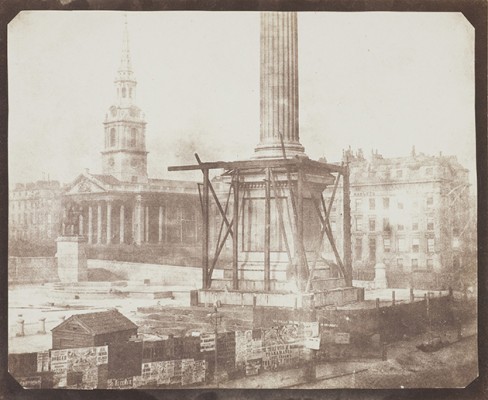
Turn the clock back 175 years when the emerging photographic trend of the day was more salt-print than selfie. Photography pioneer Fox Talbot was busy churning out prints from the earliest form of paper photography.

Yet, Fox Talbot’s work lives on today, bringing history to life in an exhibition at Tate Britain that documents daily activities and key moments of the mid-19th century, such as the building of Nelson’s Column."

Read more at Amateur Magazine

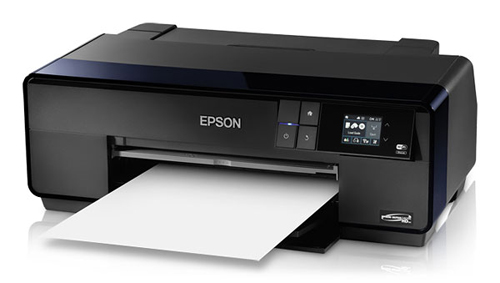
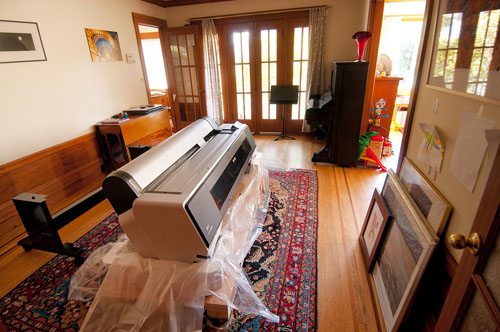
ICC Profiles Now Available For the Epson SureColor P600

The all-new Epson SureColor® P600 features incorporates all new Epson UltraChrome® HD Ink for extraordinary exhibition-quality prints. With unprecedented black density and breakthrough Resin Encapsulation Technology, the P600 delivers the richest blacks with an incredible level of sharpness. Three-level Black Ink technology delivers smooth tonal transitions for the finest black-and-white prints. High-capacity, individual ink cartridges improve your productivity with fewer user interventions. Advanced media handling allows you to easily print with a wide variety of fine art and roll papers. Create borderless 13" x 19" prints and panoramas over 10 feet long. Whatever you print, the SureColor P600 delivers such dramatically bold images, it sets a groundbreaking new benchmark in photographic quality.

Please see ICC Profile Downloads for Moab Paper to create your perfect print. 

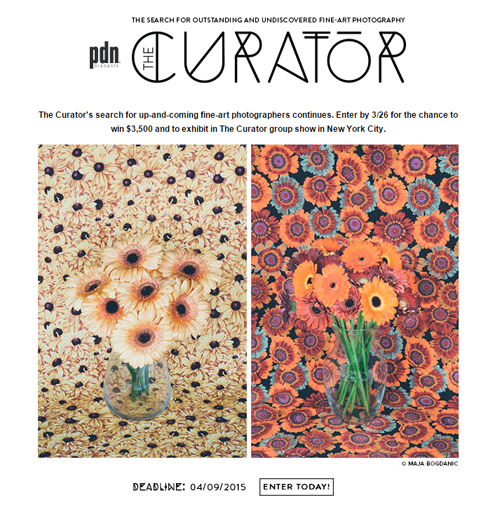
Maja Bogdanic was one of six fine-art photographers who exhibited her work in The Curator group show last summer. Her work, "Patterned," was inspired by her high school years in Serbia, where she studied fashion and textile design and was taught to find influence in nature. The series (pictured above) explores the relationship between nature and patterns through vivid, graphic imagery.

In addition to the group show, The Curator 2015 is offering the following prizes:


One Grand-Prize winner will receive a:

$3,500 Cash Prize

Six winners will receive a:
$200 gift card from B&H
VIP Expo Pass to PDN PhotoPlus Expo Oct 22–24, 2015
$250 gift card to moabpaper.com
Categories: Premium Portfolio Membership

The winners will also be published in a gallery in the July issue of PDN and an extended online gallery.

Visit www.pdncuratorawards.com/about.shtml for all information on how to enter this year's competition.

Sponsored by: PDN PhotoPlus logo Moab logo B&H logo

Scenes from a Spacewalk- A Starry Night at the National Air and Space Museum

Enjoy an exclusive after-hours program at the National Air and Space Museum's newest exhibition:Outside the Spacecraft. Immerse yourself in the gallery's artifacts and artwork through creative activities and one-on-one conversations with the exhibition curator, featured artist, and an astronaut—all while indulging in cocktails and hors d'oeuvres inspired by the exhibition.

While most of us will never wear a spacesuit to repair the Space Station or use a tether to stay attached to a spacecraft, this rather unnatural line of work inspires and fascinates us. Join exhibition curator Jennifer Levasseur, art photographer and author Michael Soluri, and a very special guest, NASA associate administrator for science and former astronaut John Grunsfeld, to hear musings on their work, and experience the rich visuals created from it. Witness how reflections within the artwork can change our experience of it and set off on a challenge to find those reflections. Discover more about living and working in space with our Education team, and do not miss the opportunity to get into gear for your spacewalk photo op.

Tickets: $35, cost of admission includes a light food and beverage reception.
All discounted tickets have sold out. A limited number of regular tickets are still available.

Illuminated Ground- The Fine Art Photography of Michael Zide

"What is fine art? How do we distinguish works of fine art from other photographic pursuits? It’s a muddled issue at best. These days, there is no end to the stunning and artfully constructed photography work to be seen in print, online, or in galleries. Many of these photos captivate us with their beauty, and inspire us with ingenuity, imagination and their craftsmanship. Regardless of how narrow our particular area of photographic interest, arresting examples can be found by typing a few key words into your computer’s search engine. The level and range of creativity and originality has never been higher."

-Michael Zide

 View Michael Zide's Manfrotto Tutorial, Illuminated Ground

Making the Artisanal Inkjet Print

Moab Master, Harold Davis, was recently asked by an art gallerist he works with to help educate some clients regarding his printmaking. Essentially the issues come down to exploring how his prints differ from mass-produced inkjet prints, since largely the same equipment is used. In contrast to those you get from Costco or giclees from an art reproduction company, Harold's prints require a great deal of hand labor. Harold's FAQ: Prints by Harold Davis covers much of this ground, and the following discussion helps put things in perspective.

Harold Davis answers many questions frequently asked by printmakers such as:

What printer do you use? How long does it take you to make a print? Are your prints limited editions? Do you hand sign your prints? Is a certificate of authenticity available? And our personal favorite: What papers do you use?

Discover Harold's printmaking insight and perspective. 

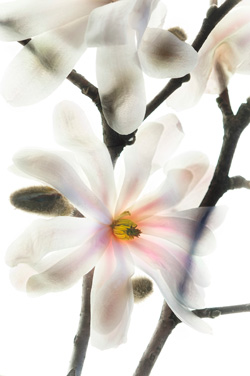
Photographing Flowers for Transparency

Master photographer Harold Davis is well-known for his often imitated—but seldom equaled—digital images of luscious transparent and translucent flowers.

In a unique 5-day workshop offering at Maine Media Workshops+College, Harold Davis shows the techniques he pioneered to create his floral masterpieces. Arrangement, composition, photography, and post-production will all be covered, as will Harold's special techniques for shooting on a light box. In addition, several sessions will explore field floral photography, and alternative techniques related to the studio photography of flowers. Harold will also show his spectacular botanical prints in the context of a discussion of the best way to create prints of floral imagery.

Don’t miss this rare opportunity to enhance your floral photography by learning from Harold Davis, the best-selling author of award-winning Photographing Flowers: Exploring Macro Worlds with Harold Davis.

Workshop participants will be given the opportunity to compose, photograph and post-process their own transparent floral images from beginning-to-end during the workshop.  Field and studio sessions will demonstrate creative techniques across the gamut of different kinds of flower photography, and allow plenty of time for individual image making. The emphasis of this workshop will be to support each participant, enabling their own unique vision and helping them to become the best flower photographer they can be.

Welcome to John Stanmeyer, Our Newest Moab Master

Moab is proud to have John Stanmeyer join the Moab Master team. 

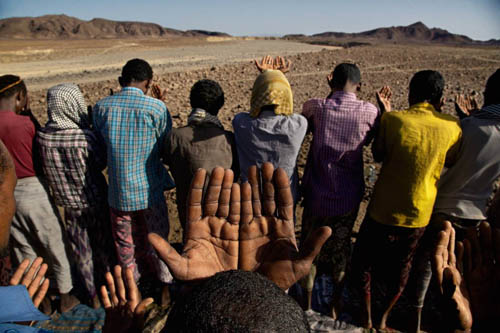
Working regularly for National Geographic Magazine, was on contract with Time Magazine for over 10 years and photographing for numerous other global publications, Stanmeyer has been the recipient of numerous honors including the prestigious Robert Capa award, named Magazine Photographer of the Year, awarded numerous World Press, Picture of the Year and NPPA awards and in 2008 received the National Magazine Award for this in-depth essay on the global Malaria epidemic.

Having printed for years my work in exhibitions at galleries and museums around the world, no other paper renders more beautifully and effortlessly than Moab Exhibition Luster 300. I am elated to have embraced with passion and purpose all my printing to paper that presents humanity as I had borne witness to 

-John Stanmeyer


Photography Talk with Michael Zide

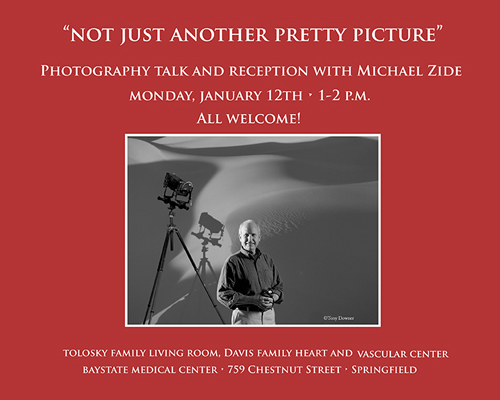
Join us for a reception and gallery talk with Michael Zide, “Not Just Another Pretty Picture”, a visual presentation about making more pow- erful landscape photographs and developing your personal vision. Michael will speak about the thinking and technique that went into making many of his stunning landscape photographs.

A fine art landscape photographer and educator, Michael Zide has created a body of work that has been featured both internationally and in galleries from New York City to Los Angeles. A member of Moab fine art paper Master Photographers Program and contributing writer for the Manfrotto School of Xcellence, his landscape images are in museum, corporate and private collections.

Michael Zide’s work is currently on exhibit in the Baystate Arts Alive

Gallery, Daly 3, MRI Connector. Refreshments served. FREE!


Travel Photographer of the Year- Wild and Vibrant

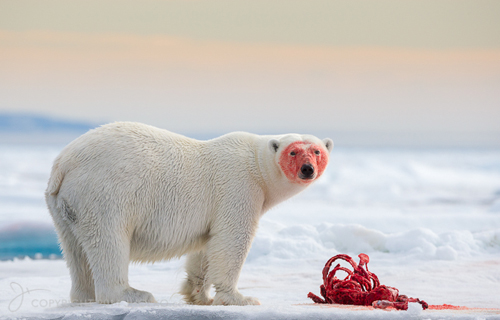
Congratulations to Moab Master, Joshua Holko, for winning the 2014 Travel Photographer of the Year award in the Wild and Vibrant category after a two month journey in South Georgia Island, Patagonia and Antartica. Joshua Holko used Somerset Museum Rag for his prints. 

"Travel photographer of the Year is one of the few remaining competitions that still judge the printed image and it is a massive thrill and honour to have won the Single Shot Wild and Vibrant Category with one of my Polar Bear photographs from Svalbard in the Arctic. 

The winning photograph has subsequently been featured by the UK Daily MailNational Geographic Itlay, The GuardianThe UK Telegraph, the German news website Spiegel Online and more. Winning Travel Photographer of the Year in the Wild and Vibrant Category has topped off for me what has been a truly incredible year in the competition arena. The standards in these competitions are incredibly high and it an immense honour to win the category."

-Joshua Holko